Thursday, November 28, 2013

Philadelphia History Museum


Title: John Brown’s Musket
Year: 1850
Material: Wood and Metal
Creator: Suhl, Germany
Collection:  Historical Society of Pennsylvania

This object is a musket rifle owned by Abolitionist John Brown in the 1850s. It is inscribed: John Brown's Gun, Harper's Ferry, October 16-19th, 1858, presented to Francis N. Thorpe by Rob't Purvis Dec'r 18, 1889. The inscription suggests that this gun was carried during Brown’s raid of Harper’s Ferry in 1859. 

http://www.philadelphiahistory.org/sites/default/files/jpg%2072%20dpi%201928.10%20Musket.jpghttp://memory.loc.gov/ammem/aap/photo08.jpg


This object is important to any one interested in American history, the Civil War, slavery, military history, and people who are interested in historic weapons. This object may not be important to people that do not like guns or people that have no understanding or connection with John Brown.

This object is on display as part of The Ordinary, Extraordinary, and the Unknown: The Power of Objects exhibit. The musket is being displayed to show the meaning of the object and its connection to Philadelphia. The Historical Society of Pennsylvania as a gift from Mrs. Francis N. Thorpe acquired the gun in 1928. The object is displayed among other objects that are unusual or interesting. This includes a wampum belt received by William Penn, George Washington’s desk, and General Meade’s presentation sword. These object add to your understanding of the broad nature of Philadelphia history. They also add to your understanding of how linked Philadelphia was to important parts of American History. The musket is accompanied by a short text panel. The panel is written from the point of view of the museum. It simply describes the object, date, inscription, and collection. There is also some information about the object’s importance, as it shows Brown’s stance on violence. It also mentions that the owner of the musket after Brown’s death was a Philadelphian and abolitionist. The main point of the text is that Philadelphia played a central role in the abolitionist movement.  Opposing points of view about this object might include people from Harper’s Ferry. Brown brought violence to that town and they might have a different opinion about the significance of the musket.

Field of study for this object might include; military history, Civil War, Harper’s Ferry, American history, John Brown, Slave revolts/raids, abolishment of slavery, and Pennsylvania history. 


To engage visitors with this object it might be interesting to do a program where there was a reading or skit of how the event at Harper’s Ferry occurred. It might also be interesting to look at images of John Brown that were created after the attack. Comparing the images and their theme of violence might offer some interesting conversations about the mindset of Brown and other abolitionists at the time.  

http://www.onthisdeity.com/wp-content/uploads/2010/10/hf-john-brown.jpg 

Video about Harriet Tubman:
 Ask a Slave Web Series: The actress worked at Mt. Vernon as an interpreter. The videos are based on questions she was asked.

Thursday, November 21, 2013

African American Museum of Philadelphia


Title: Letter from Cato, Freeman’s Journal
Year: September 21, 1781
Material: Paper
Creator: Cato, a Pennsylvania Slave
Collection: The Gilder Lehrman Institute of American History, Seen at the African American Museum of Philadelphia


This object is a letter sent to the Freeman’s Journal Newspaper from a slave named Cato. Cato was writing to urge the Pennsylvania Assembly to uphold the Gradual Emancipation Act. The Act freed slaves who weren’t registered according to the law’s provisions. The Assembly rescinded the Act, which returned those freed back to bondage. Cato was one of the slaves that were freed by the law.

This object is important to a variety of people. Anyone interested in early American history or the history of slavery would find this object important. This object is also important to the history of the Pennsylvania government as well as the federal government. It is also important to the African American community as a stance against slavery and injustice.

This object is on display because it details an event in early American and Pennsylvania history that deals with the issue of slavery. This object is an image of the original so the museum only acquired permission to use the image. It is part of a larger multi-media exhibit. The object is displayed among multiple images of notable African Americans and important documents. This particular object is at the left end or the beginning of the timeline since it was written in 1781. During portions of the multi-media “show” the document is illuminated to discuss a theme. There is a text panel with a small picture of the document next to it. The text is written from the point of view of the museum, but through an African American voice. The text expresses how slaveholders (whites) opposed the law. The text also directly quotes Cato, which gives his personal perspective as an African slave. The images surrounding the object highlight other parts of the African American story in Philadelphia. They don’t all directly relate, but they create a broader picture of the historical timeline.

This object may not be interesting to people who aren’t interested in early Pennsylvania history or people who aren’t interested in reading about slavery. Opposing points of view for this object might include Cato’s master. He would have direct and opposing opinions about the content of Cato’s letter. I think that other area newspapers might have had some opposition viewpoints as well. Obviously the views of the slaves differed from everyone else.

Fields of study for this object might include: American history, African American history, Pennsylvania history, Philadelphia history, Late revolutionary history, history of slavery, history of newspapers, and history of letters to the editor.

I would like to compare this letter to other letters slaves or former slaves wrote to a paper. This would include comparing the issues discussed and what the context of the subject is. There is another letter from 1780 that might be interesting to compare. 

It might also be interesting to do a classroom activity where kids were assigned a slave narrative/letter that they would read to the class and discuss the point of view and feelings of that person.


Exchange between “Rusticus” and “Africanus,” 
in Gazette of the United States, March 3, 1790.


Saturday, November 16, 2013

Penn Museum


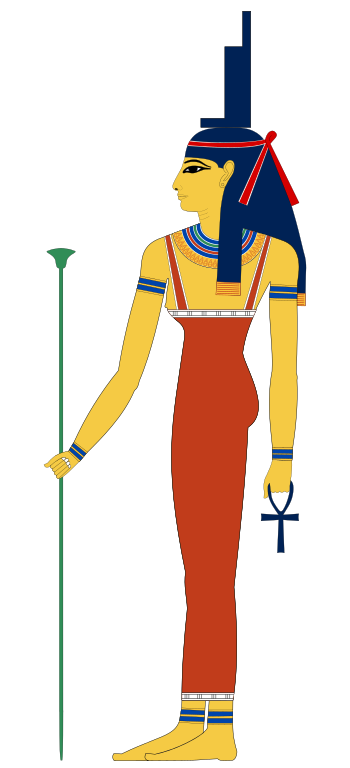
File:Isis.svg
Isis
Title: Isis Nursing Horus
Year: Late Period, 575 B.C.
Material: Bronze
Creator: Saqqara, Egypt
Collection: University of Pennsylvania Museum

This object is a statuette of the Egyptian goddess Isis nursing her son, the god Horus. Isis is the goddess of motherhood, magic, and fertility.
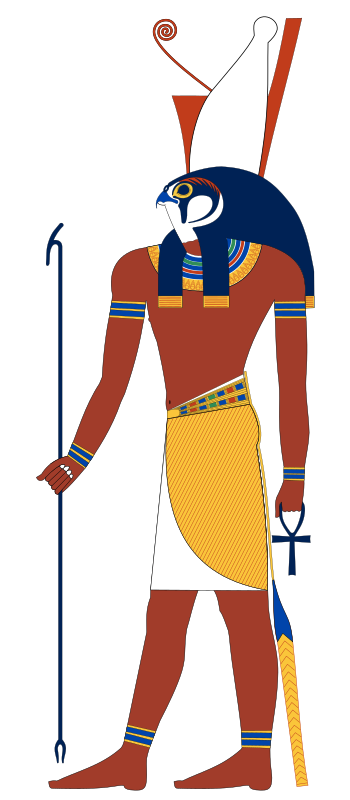
Horus is the god of war, sky, and protection. He is the most important god in the Egyptian religion.

File:Horus standing.svg
Horus
This object is mostly important to scholars today, although it still has some importance to Egyptian culture. Scholars can learn a great deal about ancient Egyptian culture and religion by studying the gods and goddesses. The relationships between the gods reveal a lot about the complex nature of the Egyptian religion. For example, Isis was married to Osiris, the god of the dead; he was murdered by another god, Set, and cut into pieces. Later after Horus was born, Seth was enraged and tried to catch Isis and Horus. Isis hid in the Nile River Delta and invoked divine powers to protect them. This object is also and important art piece. Is important to see the evolution of Egyptian craftsmanship.

This object might not be important to people that aren’t interesting in ancient cultures. This object may not be interesting to people that practice and orthodox religion that condemns polytheism.
This object was most likely acquired during the museum’s early collection period. I assume that is was a gift or part of an expedition of some kind. The statuette is on display in a glass case sitting on a red box. It looks like this statuette was part of an alter or another decoration. The object is next to other statuettes and a large mural. These objects contribute to our understanding of Egyptian art and religion. This object is on display to represent two of the most important figures in the ancient Egyptian religion. The label for this object includes the typical information: item, date, location, material, and size. Below this there is a short paragraph explaining the story of the birth of Horus. The text seems to be written from the point of view of a curator, however the text is easy to comprehend. I felt like the text missed a key point. It doesn’t directly talk about Isis, but Horus. It also doesn’t directly mention that Isis is Horus’s mother. The context is hard to understand unless you read all of the text before this object. An opposing point of view about this object might be from someone in the cult of Isis. They would view Isis as a more important god than Horus. Another opposing point of view might be anyone who doesn’t believe in mythology. They might tell a narrative that doesn’t highlight the importance of Isis as a goddess, but as a mythological being. 

Other fields of study that would add to your understanding of the object includes: Egyptology, mythology, book of the dead, Osiris, and ancient Greece.

V39
Tyet
To engage visitors with this object I would like to have other versions of the same statue and compare them to its Christian counterpart. The image of Isis nursing Horus was the precursor to images of Mary and Jesus. I think it would also be interesting to tell the story of Isis and Horus in the gallery. This could be done several ways. I think paper theater would be cool. However, there are some parts of the story that are inappropriate for kids. I am not sure if it would be right to omit those parts or just not make them explicit. Isis also has a symbol associated with her, tyet. This would be a fun craft to make with kids. A tyet was usually used as a funerary amulet.


Friday, November 1, 2013

American Swedish Historical Museum


Title: Martin Luther’s Small Catechism Translated into Algonquin Indian
Year: 1696
Material: Paper/Leather
Creator: Johannes Campanius
Collection: American Swedish Historical Museum Rare Books Library


This object is a book of Catechisms translated for the Algonquin Indians of the Delaware River Valley. Catechisms give a brief summary of the basic principles of Christianity in question-and-answer form. The author of this translated book was a Swedish missionary who served the colony of New Sweden. This object was used to spread Christianity in the new world.

This book is important to several people. This book is important to people studying colonial, European, and Native American history. This book is also important to religious studies as well as linguistic studies. It is also important to the remaining tribes of the Delaware River Valley. Most tribes are trying to revive their native language. Having this book could be helpful. Also this book is important because it shows what some of the motives of the New Sweden Colony were. This object may not be interesting or important to people who aren’t interested in history or religion. The topic of New Sweden adds a challenge to this object. It seems that most people don’t know this colony even existed, therefore it seems that this may be the reason some people wouldn’t be interested in the book.

This book is part of the New Sweden Colony exhibit. The book contributes to the larger story of colonization in the Delaware River Valley by the Swedish. This object is displayed to show that the Swedish colony interacted with the local native population. It is also on display to show that the Swedish were one of the first colonies to try to spread Protestantism. The book is displayed next to other books, maps, and documents that reveal the impact the colony had on the area.  The label text for this object is interesting. The label is located next to all of the other labels for the objects on the wall. The text is written in the museum’s point of view, however the text is very simple and direct. It simply states what the object is, who made it, and why it is important to the legacy of the colony of New Sweden.

An opposing point of view about this object could paint a negative picture. The exhibit and the label as it is written now show this object as a positive legacy of the colony. The Native American perspective may see this object as a negative thing that intruded on their culture. Non-Swedish Americans and Americans without Swedish ancestry might also have an opposing viewpoint about this object.

Fields of study for this object include American history, European history, Swedish history, Native American history, book arts, linguistics, and anthropology. Another resource might be rare book collectors.

To further engage people with this object I think it would a good idea to do a weekly page turning. The book is currently opened to the title page. I think it would be interesting to see the inside pages of the book and possible show a small translation of the book. I would also like to do a program that would teach people about the relationship between the Algonquin and the Swedish. This program would highlight both cultures and show how they interacted when the colony was founded. I think it would also be interesting to do a program that teaches Swedish and Algonquin word or phrases to show how different the languages are and how thing could get lost in the translation of the book.